Introduction
Planning a road trip with a large group sounds exciting until someone asks: “Wait, how are we all getting there?”
That one question opens a door to weeks of back-and-forth — who’s driving, whose car fits how many people, what happens when three cars get separated on the highway, and who’s responsible when someone misses the exit.
Multi-city road trips with large groups don’t fail at the destination. They fall apart in the planning — specifically, the transportation planning.
This guide covers exactly how to structure a multi-city group road trip from start to finish: how to pick your route, how to manage a group that size on the road, what most groups get wrong the first time, and why a single 15-passenger van rental changes the entire equation.
Whether you’re planning a family reunion road trip through Florida, a sports team tournament circuit, a church group retreat, or a friend group weekend across multiple cities — the framework is the same.
Why Multi-City Trips Are Harder Than Single-Destination Trips
A single-destination trip has one failure point: getting there.
A multi-city trip has a failure point at every transition — every city change, every stop, every new route segment. And with a large group, each failure point is multiplied by however many people are in your party.
The compounding problems look like this:
Timing gaps. When your group is split across multiple vehicles, each transition between cities creates a new coordination window where things go wrong. Someone’s car is 20 minutes behind. Now the restaurant reservation is at risk. Now the hotel check-in window is closing. One delay becomes three problems.
Navigation fragmentation. The lead car knows the plan. The second car is following GPS. The third car took a different route because someone thought they knew a shortcut. By the time all three cars reach the next city, your group has had three completely different arrival experiences.
Energy depletion. Long driving days are tiring. When different parts of your group are in different vehicles experiencing different driving conditions — some hit traffic, some don’t — they arrive at different energy levels. That affects how much everyone actually enjoys the stops.
Cost multiplication. Fuel, tolls, and parking multiply across every vehicle for every city. What seems like a cost-saving decision to use multiple cars often ends up costing more than a single van rental by the time the trip is done.
One van eliminates all four of these problems simultaneously.
Step 1 — Build the Route Before You Book Anything
The most common mistake large groups make is booking accommodation and activities before locking in the transportation logic.
Route first. Everything else second.
For Florida multi-city road trips, the most common working routes are:
Tampa → Orlando → Miami (or reverse)
Covers gulf coast, theme parks, and south Florida in one logical flow. Approximately 280 miles total. Manageable in 3–4 days.
Orlando → Sarasota → Tampa
Central Florida to Gulf Coast. Shorter circuit — good for weekend trips. Approximately 150 miles total.
Miami → Fort Lauderdale → Orlando → Tampa
Full South-to-North Florida circuit. Best for groups with 5+ days. Approximately 310 miles.
Atlanta → Tampa → Orlando
Southeast-to-Florida corridor. Popular for church groups and sports teams coming from Georgia. Approximately 680 miles round trip.
Route planning principles for large groups:
Drive time between cities should not exceed 3 hours per segment. Beyond 3 hours, group energy degrades significantly — especially with families or mixed age groups.
Build in one unplanned stop per every 2 hours of drive time. Large groups always need more stops than small groups. Fighting this reality adds tension.
Plan your heaviest activity day in the middle of the trip, not at the start or end. Groups arrive energized and leave tired — front-loading or back-loading your biggest day wastes that energy curve.
Step 2 — Figure Out Transportation Before Anything Else

This is where most groups make their costliest mistake.
They assume transportation will “figure itself out” — someone will drive, cars will work out, rideshares will fill the gaps. This assumption is what turns a good trip into a coordination nightmare by day two.
For groups of 8–15 people, a 15-passenger van rental is the only transportation option that actually works across multiple cities. Here is why every alternative falls short:
Multiple personal vehicles: Different departure times, different routes, different arrival windows. You spend the first hour of every city trying to regroup. Parking fees multiply. Fuel costs multiply. One car has a problem and the whole group is affected.
Rideshares across cities: Surge pricing on travel days, no luggage guarantee, and zero group coordination. This works for a dinner outing in one city — it does not work for a 3-city road trip with 12 people and luggage.
Charter buses: Often cost-prohibitive for groups under 30 people and require fixed itineraries. No flexibility for unplanned stops or route changes.
One 15-passenger van: One departure. One arrival. One fuel stop. One parking decision. One navigation plan. Every transition between cities is clean, coordinated, and on schedule.
What to confirm when booking your van for a multi-city trip:
Miles — confirm your estimated total mileage upfront. If your route requires more miles than the standard allotment, flag this before booking so it is handled in advance.
Out-of-state travel — if your route crosses state lines, confirm this with Nation Van Rentals at booking. Different routes have different requirements and this needs to be known upfront, not discovered on the day.
Pickup and drop-off location — confirm which location works best for your starting point. Nation Van Rentals operates across Tampa (Downtown and Airport), Orlando, Miami, Sarasota, and Atlanta.
That is all the logistics that need confirming. Your itinerary is your business — the van handles the transportation.
Step 3 — Accommodation Strategy for Large Groups
Hotels and short-term rentals have completely different math when you are traveling with 10–15 people.
Short-term rentals (Airbnb, VRBO) usually win for large groups — one large house often costs less per person than multiple hotel rooms, keeps the group together in the evenings, and gives you kitchen access that reduces meal costs significantly.
The trade-off: availability requires early booking. Large-capacity properties in Florida cities — especially near Orlando theme parks and Miami Beach — book out weeks in advance for weekend dates.
When hotels make more sense:
When the group has varied sleep schedules and needs separate spaces. When the trip is primarily conference or event-based and the hotel is the event venue. When a short-term rental requires a minimum stay longer than your city segment.
Practical accommodation tips for multi-city group trips:
Book accommodation before you finalize activities — not after. The best large-group properties in popular Florida cities go fast.
For a 3-city trip, aim for 1–2 nights per city minimum. One night in a city with a large group rarely justifies the load-in and load-out effort.
Coordinate checkout time with your departure time. Large groups take longer to check out than expected — build in 30–45 extra minutes.
Step 4 — Meal Planning That Does Not Derail Your Schedule
Food decisions are where multi-city group trips lose the most time.
With 10–15 people, spontaneous restaurant decisions create 20-minute debates that turn into 90-minute waits. Every unplanned meal stop has the potential to push your next activity, your next city arrival, and your accommodation check-in.
The system that works:
Designate one person as the food coordinator for each city segment. Their job is to have 2–3 restaurant options pre-researched and bookable for the group’s time window. Not a committee — one person with final decision authority on meals.
For highway driving segments, pack a cooler in the van with snacks, drinks, and simple food. Stopping a 15-person group at a highway rest stop for a meal costs 45–60 minutes minimum. A cooler reduces that to 15 minutes.
Make reservations everywhere that accepts them. Many Florida restaurants require reservations for groups over 8 — call ahead, not same-day.
Step 5 — Managing Group Energy Over Multiple Days
The hardest part of a multi-city road trip is not the logistics. It is managing 10–15 people’s energy levels, preferences, and patience across 3–5 days.
Some practical principles that experienced group travel organizers use:
Build in one free afternoon per trip. No planned activities, no group obligations — people split up, rest, explore independently, and regroup for dinner. This resets group energy better than any single activity.
Have a clear daily decision-maker. Rotating leadership works poorly in large groups because accountability gets diffuse. Designate one trip organizer whose decisions are final on timing, routing, and schedule conflicts. Others can provide input — one person makes the call.
Separate the van from the itinerary. The van’s job is transportation — it is not a committee room. Finalize plans before you get in, not during the drive. Decision fatigue in a moving vehicle with 12 people is a guaranteed source of tension.
Set a realistic departure time and stick to it. Large groups always underestimate morning prep time. If you need to leave at 9 AM, tell the group 8:30 AM. Build the buffer into the plan, not into the stress.
Popular Multi-City Routes From Nation Van Rentals Locations
From Tampa:
Tampa → Clearwater Beach → Sarasota → Fort Myers. Gulf Coast circuit, approximately 2–3 days. Best for beach-focused groups and families.
Tampa → Orlando → St. Augustine. History, theme parks, and coastal Florida in one route. Approximately 3–4 days.
From Orlando:
Orlando → Miami → Key West. The ultimate Florida road trip — approximately 4–5 days. High mileage, high reward. Confirm out-of-state status not applicable — Keys are still Florida.
Orlando → Tampa → Crystal River. Nature-focused circuit with springs, Gulf access, and state parks. Approximately 2–3 days.
From Atlanta:
Atlanta → Chattanooga → Nashville. Southeast circuit for groups based in Georgia. Approximately 3–4 days. Confirm out-of-state travel at booking.
Atlanta → Savannah → Jacksonville → Orlando. Full Southeast-to-Florida run. Approximately 5 days. Popular for church groups and family reunions.
From Miami:
Miami → Fort Lauderdale → Palm Beach → Orlando. North Florida circuit from South Florida. Approximately 3–4 days.
What Nation Van Rentals Handles — And What You Handle
This is where a lot of groups overthink the rental process.
Nation Van Rentals handles:
The vehicle — clean, inspected, and ready at your pickup location. The capacity — up to 15 passengers comfortably. The reliability — consistent fleet maintained to road-ready standard.
You handle:
Your itinerary. Your activities. Your accommodation. Your schedule.
You do not need to share your plans, your stops, or your daily schedule with the rental process. The only transportation details that matter at booking are your estimated mileage, whether your route goes out of state, and your pickup location.
Everything else is yours to plan however works best for your group.
Ready to Start Planning?
A multi-city road trip with a large group is one of the best travel experiences possible — when the transportation is handled correctly from the start.
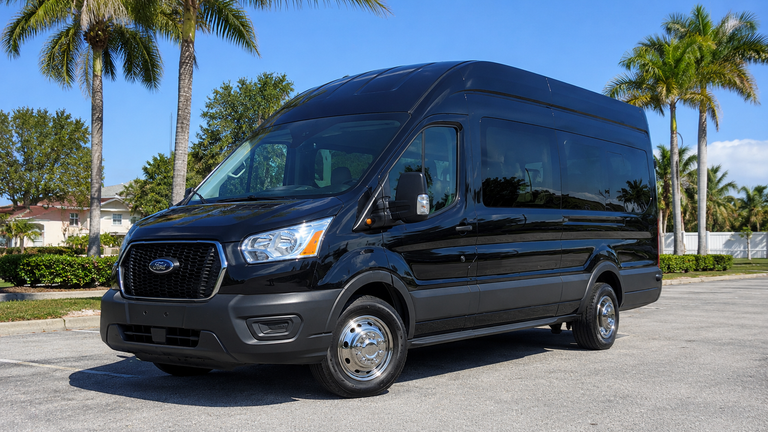
Nation Van Rentals operates across Florida and Atlanta, with locations in Tampa (Downtown and Airport), Orlando, Miami, Sarasota, and Atlanta. 15-passenger Ford Transit vans, straightforward booking, and no hidden complexity.